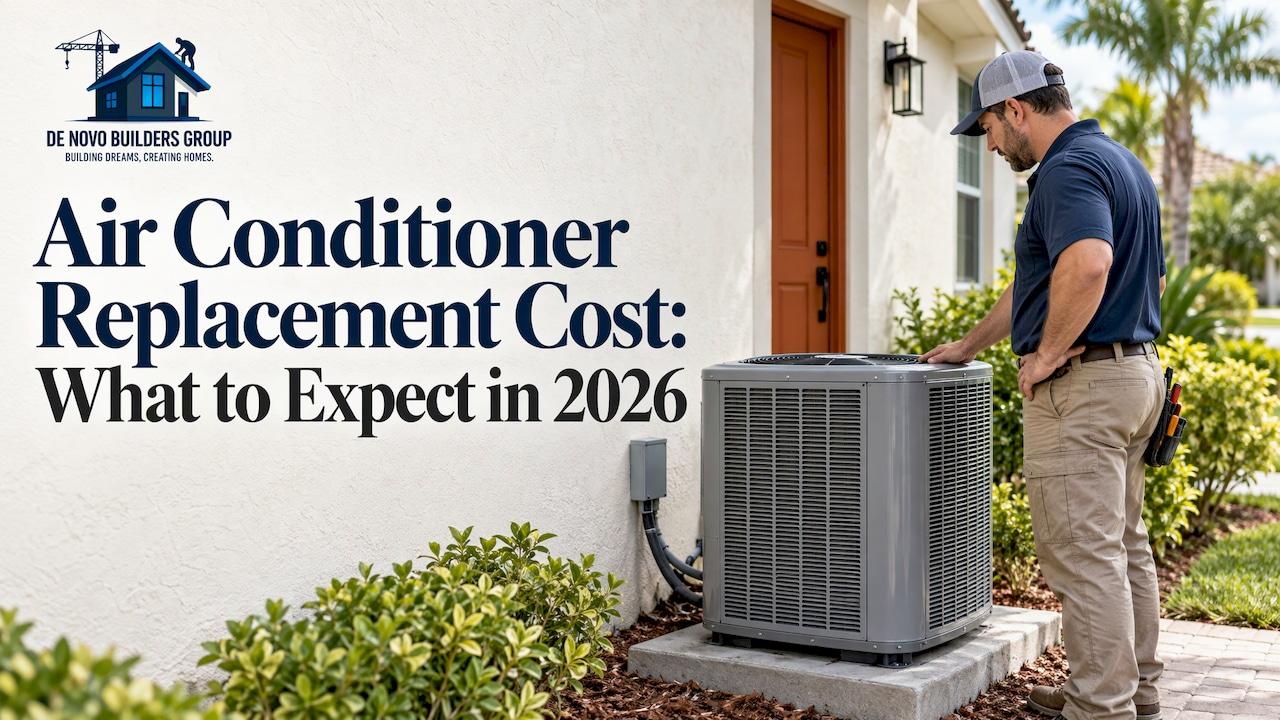
Most homeowners replacing a central air conditioner should plan on roughly $5,000 to $13,000 installed, and the exact figure depends on four things: the size of the system, its efficiency rating, the condition of your ductwork, and how complicated the installation is. National manufacturer guides put the full range anywhere from $3,000 to $15,000 or more. That spread is wide because a like-for-like swap on a small home and a full indoor-and-outdoor replacement with duct repairs are very different jobs.
This guide shows you what the number is made of, how to read an estimate line by line, how to decide between repairing and replacing, and what to do before you sign. If you live in Palm Beach County and want HVAC work handled by a licensed, insured general contractor, our HVAC page lists what we install and service.
TL;DR
- A central AC replacement typically lands between about $4,000 and $13,000 installed, with Trane's 2026 estimate for its own systems at $6,958 to $13,418.
- Tonnage (size), SEER2 efficiency, ductwork condition and installation difficulty move the price most.
- A good estimate itemizes the outdoor unit, indoor coil, line set, pad, permits, thermostat, labor, old-equipment removal and warranties.
- The "$5,000 rule" is a quick screen: multiply the unit's age by the repair quote, and if the result is above $5,000, price a replacement.
- Get three detailed written quotes, and compare them line by line, not by the bottom number.
Table of Contents
- What a central AC replacement costs in 2026
- What drives the price up or down
- What a good estimate should list
- Repair or replace: the $5,000 rule
- When replacement is cheaper
- How to compare quotes, step by step
- How we handle HVAC replacement in Palm Beach County
- Planning your budget
- FAQ
- Sources
What a central AC replacement costs in 2026
Every published figure is a planning range, not a quote. Here is how the main national guides compare, all for 2026:
| Source | Installed range | What it covers |
|---|---|---|
| Carrier | $3,000 to $15,000 or more | Central AC replacement, all home sizes |
| Trane | $3,900 to $13,500 (basic to high-end); $6,958 to $13,418 for its AC systems | National estimate |
| Bryant | $5,000 to $28,000 | Wide residential range, reflecting tonnage, SEER2, ductwork and regional labor |
The low end usually means a smaller home, a standard-efficiency unit and easy access. The top end usually means a larger home, a high-efficiency or variable-speed system, and extra work on ducts or electrical service. If a quote falls outside the range, that is not automatically a problem. It is a prompt to ask which line items explain the difference.
A useful way to think about it is in three tiers:
- Basic replacement. A properly sized, standard-efficiency system going in where the old one came out, with ducts in good shape.
- Mid-range. Higher efficiency, a better thermostat, and some modifications to the pad, line set or electrical disconnect.
- High-end. Top efficiency, variable-capacity equipment, duct modifications or replacement, and difficult access such as a tight attic or a rooftop unit.
You may also see this as the cost to replace a whole-home system versus the "outdoor unit only" swap. The two are not the same job, and the price should reflect that.
What drives the price up or down
Carrier's guide lists the main variables: system type and capacity, SEER2 efficiency, compressor type, home size, climate and region, existing ductwork, installation complexity and optional features. Here is what each one means in practice.
Size (tonnage)
AC capacity is measured in tons. A bigger home or one with more sun exposure needs more capacity, and larger equipment costs more. The trap is that bigger is not better. An oversized system cools quickly, shuts off, and runs short cycles that handle humidity poorly. Trane notes that a dealer may run a load calculation, a room-by-room calculation of how much cooling your home actually needs, and that is the step that should set the tonnage, not the size of the old unit.
Efficiency (SEER2)
SEER2 is the current efficiency rating for air conditioners: the higher the number, the less electricity the system uses for the cooling it delivers. Higher-efficiency equipment costs more up front but can reduce energy bills over time. In a climate where the air conditioner runs for much of the year, that trade-off deserves a real look. Ask for side-by-side options at two or three SEER2 levels, and ask what each would cost to run, so you can weigh the payback yourself.
Compressor type
Single-stage compressors run at full output or off. Two-stage and variable-speed designs adjust output and cost more. They tend to run quieter and hold temperature more evenly, which is what you are paying for.
Ductwork
This is the most common source of surprise. If your ducts are leaking, undersized or damaged, a new air conditioner will not perform the way it should. Bryant's guide notes that major duct, electrical, structural and optional upgrades may be excluded from a quote unless they are listed. Ask directly whether the ducts were inspected and whether any work on them is in the price.
Installation complexity
Carrier estimates that swapping only the outdoor unit takes 4 to 8 hours, while replacing both outdoor and indoor equipment typically takes 8 to 14 hours of labor. Add difficult access, a new electrical circuit, a relocated air handler or a new pad, and labor climbs.
What a good estimate should list
Two estimates with the same bottom number can describe very different jobs. According to Bryant, a comprehensive quote should list these items:
- The outdoor unit (condenser)
- The evaporator coil and indoor interface
- The refrigerant line set
- The equipment pad
- Permits and inspections
- The thermostat
- Installation and startup
- Removal of the old equipment
- Warranties
Source for the list: Bryant's 2026 cost guide. Use it as a checklist. If a quote lumps everything into one number, ask for it broken out. If a line is missing, ask whether it is excluded or simply unlisted, because that is where a lower quote often comes from.
The model number is worth asking about too, since it tells you the tonnage and the efficiency rating you are actually paying for. And ask about the warranty terms in writing: what is covered, for how long, and whether labor is included.
Get three detailed quotes
Trane recommends obtaining three detailed quotes because each contractor assesses your home and can price equipment at different efficiency levels. The point is not to find the lowest number. It is to see whether the three scopes match. If one quote assumes a new coil and another reuses the old one, they are not comparable.
A worked example makes the point. Say you receive $7,200, $8,900 and $6,100. The $6,100 quote does not list permits or a new thermostat. The $8,900 quote includes a new line set and a pad. Once you add the missing items to the lowest quote and take away the extras from the highest, the three may sit within a few hundred dollars of each other. You only find that out if each quote is itemized.

Repair or replace: the $5,000 rule
If your system is still running but costly to fix, there is a quick screening method. Bryant describes it as the $5,000 rule: multiply the unit's age in years by the estimated repair cost. If the result is above $5,000, consider replacing.
Bryant's own example is a 10-year-old unit needing a $600 repair, which gives $6,000, so replacement is worth pricing. A 4-year-old unit with the same $600 repair gives $2,400, so repair is the sensible call.

Treat it as a screening tool, not a verdict. The same guide stresses that condition, efficiency, repair history and expected remaining life also matter. Three repair calls in two years on a 12-year-old system is a stronger signal than any single multiplication.
Typical repairs cost far less than a replacement. One roundup of 2026 prices puts AC repairs at $250 to $700, but it is a general range and your quote will depend on the part. If your estimate for repair is a meaningful fraction of a new system and your unit is aging, ask for a replacement price at the same visit, so you can compare both options on the same day.
When replacement is cheaper
The common advice is that off-season months, when demand for cooling and heating is lower, tend to bring easier scheduling and sometimes manufacturer promotions. In South Florida, where cooling demand runs through much of the year, the quiet stretch is shorter than in northern states, so do not count on a big seasonal discount. What reliably saves money is not waiting for a breakdown. When a system fails on a hot day, you have little time to compare quotes and less leverage. Planning a replacement while the old unit still runs lets you collect three quotes, choose equipment calmly and schedule the work.
How to compare quotes, step by step
- Ask for a home assessment, not a phone price. Tonnage should come from your home's cooling needs, not the old unit's label.
- Request itemized quotes. Use the nine-item list above.
- Ask for two or three efficiency options. Compare the price difference against the energy savings you would expect.
- Ask about the ducts. Find out if they were inspected, and what work is or is not in the price.
- Confirm permits. Replacements generally need a permit and inspection in Florida counties, and the quote should say who pulls the permit. Your county building department is the authority that issues it and inspects the work.
- Check the license and insurance. In Florida, you can verify a contractor's license on the state's Department of Business and Professional Regulation website before signing.
- Get warranty terms in writing. Note the equipment warranty and any labor warranty separately.
If you are replacing an air conditioner as part of a larger project, such as a kitchen or bathroom remodel or an addition, the order matters. Routing new ducts and sizing equipment are easiest before walls are closed, and one contractor coordinating the trades avoids gaps between them.
How we handle HVAC replacement in Palm Beach County
De Novo Builders Group is a licensed and insured general and roofing contractor serving Wellington, Royal Palm Beach, Greenacres, Lake Worth Beach, West Palm Beach and the rest of Palm Beach County. HVAC installation and service is part of what we do, alongside remodeling and roofing, so a replacement can be planned together with other work on your home. We provide detailed written estimates and stay in communication through the project, and we build to local building codes.
Our HVAC page describes our installation and service work and the TotalCare365 membership. If your air conditioner replacement is part of a bigger renovation, our general contracting and design-build services cover the whole scope under one team.

If the roof above your new outdoor or attic equipment is also near the end of its life, it is cheaper to plan both together than to open things up twice. You can get a roofing price in under 60 seconds with our instant quote tool, which uses satellite imagery and needs no sales visit.
Planning your budget
Build the budget around the range, then adjust with your own facts:
- Start with the mid-range. For a typical single-family home, the middle of the national ranges is the sensible planning number.
- Add a contingency. Setting aside extra for duct repairs, electrical work or a pad is cheaper than being surprised mid-job.
- Decide on efficiency using your usage. A system that runs most of the year earns back an efficiency premium faster than one that runs a few months.
- Think about maintenance. A regular service plan keeps a new system running as designed, and our TotalCare365 membership is built around that kind of ongoing care.
The cheapest quote is rarely the best value if it leaves out the items above. The best quote is the one that lists everything, sizes the system from a real assessment, and puts warranty terms on paper.
FAQ
How much does it cost to fully replace an AC?
For a central system, national 2026 guides give ranges from about $3,000 to $15,000 or more installed. Most homes fall in the middle of that range. Your price depends on tonnage, efficiency, ductwork and how complex the installation is.
What is the $5,000 rule for AC units?
Multiply the unit's age by the repair estimate. If the total is over $5,000, replacement is worth pricing. A 10-year-old unit with a $600 repair works out to $6,000. It is a guideline, so also consider the unit's condition and repair history.
Does a replacement estimate include the indoor coil and permits?
It should. A comprehensive quote lists the outdoor unit, evaporator coil, line set, pad, permits and inspections, thermostat, labor, old-equipment removal and warranties. Major duct or electrical work may be excluded unless it is listed, so ask.
How long does an AC replacement take?
Swapping only the outdoor unit takes about 4 to 8 hours of labor. Replacing both the outdoor and indoor equipment typically takes 8 to 14 hours. Ductwork or electrical changes add time.
Sources
- Air Conditioner Prices in 2026, Carrier Residential
- What Does AC Replacement Cost?, Trane
- Air Conditioner Cost (2026), Bryant
- AC Replacement Guide: Signs It's Time to Upgrade, Bryant